

The World According To Google - satellite pictures of the most interesting places on the World, satellite maps: Most interesting places of the World (on google maps)

Choose category

Shortcut » Newest places | Posts with videos | Selected places | Submit interesting place

Interesting places:

Advertisements:

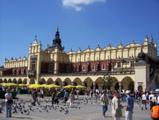
Sukiennice (Cloth Hall, Drapers’ Hall) in Cracow, Poland

February 22nd, 2008 / / Links: Google Earth, Google Maps, Yahoo! Maps, Virtual Earth / Nearest places
Share This

Sukiennice (Cloth Hall, Drapers' Hall) in Kraków, Poland, one of the city's most recognizable icons, was once a major centre of international trade. Traveling merchants met there to discuss business and to barter. During its golden age in the 15th century, it was the source of a variety of exotic imports from the East – spices, silk, leather and wax – while Kraków itself exported textiles, lead, and salt from the Wieliczka Salt Mine.

Kraków, Poland's royal capital, was among the most magnificent cities in Europe. However, its prosperity would not last indefinitely. The city's decline was hastened by wars and political ineptitude. By the time that restoration was proposed for Sukiennice in 1870, much of the historic city center was decrepit. Nevertheless, a change in political fortunes for the Galicians ushered in a renaissance of sorts, and the successful renovation of the Cloth Hall was one of the proudest achievements of this period.
(more..)

Moscow Victory Park and Central Museum of the Great Patriotic War, Moscow, Russia

February 12th, 2008 / / Links: Google Earth, Google Maps, Yahoo! Maps, Virtual Earth / Nearest places
Share This

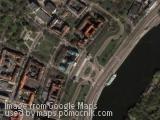
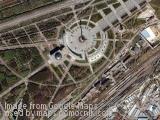
Moscow Victory Park and Central Museum of the Great Patriotic War in Moscow, Russia.

Send by: Marcinkrk


National Museum, Rio de Janeiro, Brazil

January 21st, 2008 / / Links: Google Earth, Google Maps, Yahoo! Maps, Virtual Earth / Nearest places
Share This

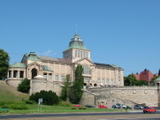
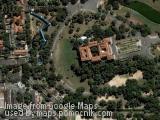
The Palace that has been home to the National Museum since 1892 was donated to the Prince-Regent John VI by

Portuguese merchant Elias Antonio Lopes in 1818. After the collapse of the Brazilian Empire, it was used as a barracks, then a school, and finally became the seat of the Assembly that drew up the first Constitution of the Brazilian Republic. Its attractions include fossil skeletons of pre-historic animals and Etruscan ceramics, as well as Egyptian mummies and sarcophagi, together with indigenous weapons and objects, stuffed animals and minerals from all over the world. Part of this collection belonged to Emperor Pedro II, who was a botanist, and his wife the Empress Teresa Cristina, an archeologist. This Museum also has a nursery garden covering 40,000 m2 and a library specializing in the natural and anthropological sciences with 442,000 volumes.

(more..)

USS Cavalla, Galveston, Texas, USA

November 19th, 2007 / / Links: Google Earth, Google Maps, Yahoo! Maps, Virtual Earth / Nearest places
Share This

The USS Cavalla is berthed in Seawolf Park, Galveston, Texas as a memorial to the lost submarine USS Seawolf. Cavalla was a Gato class fleet sub, designed and built in the summer of 1943 by the Electric Boat Company and launched on November 14, 1943. She was commissioned on Feb. 29, 1944, the first "leap year" boat built by E.B. On June 19, 1944, on her maiden patrol, she sank the 30,000 ton aircraft carrier Shokaku (veteran of Pearl Harbor and Battle of Coral Sea). This earned her the Presidential Unit Citation.

Send by: greg


HMS Caroline, Belfast, Northern Ireland

November 9th, 2007 / / Links: Google Earth, Google Maps, Yahoo! Maps, Virtual Earth / Nearest places
Share This

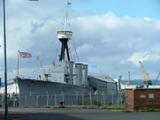
HMS Caroline is a C-class light cruiser of the British Royal Navy (RN). Caroline was launched and commissioned in 1914, making her the second-oldest ship in RN service, after HMS Victory. She acts as a static headquarters and training ship for the Royal Naval Reserve (RNR), based in Alexandra Dock, Belfast, Northern Ireland. She is the last remaining British World War I light cruiser in service, and the last survivor of the Battle of Jutland still afloat.

Send by: DKing


Marine Museum, Szczecin, Poland

November 9th, 2007 / / Links: Google Earth, Google Maps, Yahoo! Maps, Virtual Earth / Nearest places
Share This

Marine Museum in Szczecin, Poland. Built in .

Send by: Gh0st


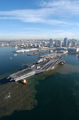
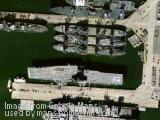
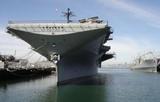
USS Midway, Alameda, California, USA

July 31st, 2007 / / Links: Google Earth, Google Maps, Yahoo! Maps, Virtual Earth / Nearest places
Share This

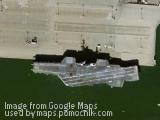
USS Midway (CVB/CVA/CV-41) was an aircraft carrier of the United States Navy, the lead ship of her class, and the first to be commissioned after the end of World War II. Active in the Vietnam War and in Operation Desert Storm, as of 2007 she is a museum ship in San Diego, California. She is the only remaining aircraft carrier of the World War II era that is not an Essex-class ship.

Midway was laid down 27 October 1943 by Newport News Shipbuilding Co., Newport News, Virginia. Her revolutionary hull design was based on what would have been the Montana class battleships and gave her superior maneuverability over all previous carriers. She was launched 20 March 1945; sponsored by Mrs. Bradford William Ripley, Jr.; and commissioned 10 September 1945, Captain Joseph F. Bolger in command.

In August 1991, Midway departed Yokosuka and returned to Pearl Harbor. Here, she turned over with Independence which was replacing Midway as the forward-deployed carrier in Yokosuka. Midway then sailed to San Diego where she was decommissioned at Naval Air Station North Island on 11 April 1992 in a ceremony in which the main speaker was Secretary of Defense Richard Cheney. She was stricken from the Naval Vessel Register on 17 March 1997. During the decommissioning process, she was used to film portions of the movie At Sea, a documentary on carrier life shown only at the Navy Museum in Washington D.C. Both sailors and their families participated in the filming or the homecoming scenes.

(more..)

USS Hornet, Alameda, California, USA

July 31st, 2007 / / Links: Google Earth, Google Maps, Yahoo! Maps, Virtual Earth / Nearest places
Share This

USS Hornet (CV/CVA/CVS-12) is a United States Navy aircraft carrier. The eighth ship to bear the name, she was originally named USS Kearsarge, but renamed in honor of the CV-8, which was lost in October of 1942.

The contract to build Kearsarge had been given to Newport News Shipbuilding on 9 September 1940, and her keel was laid down 3 August 1942. The seventh Hornet (CV-8) was sunk in the Battle of Santa Cruz on 26 October 1942, and the CV-12 hull was renamed Hornet (the name Kearsarge is still stamped into her keel plate). She was launched 30 August 1943 and commissioned 29 November 1943. Her first commander was Captain (later Rear Admiral) Miles R. Browning.

Hornet conducted shakedown training off Bermuda before departing Norfolk 14 February 1944 to join the Fast Carrier Task Force 20 March at Majuro Atoll in the Marshalls. After lending air support to protect the invasion beaches in New Guinea, she conducted massive aerial raids against Japanese bases in the Caroline Islands and prepared to support the amphibious assault for the occupation of the Marianas Islands.

(more..)
Close
E-mail It